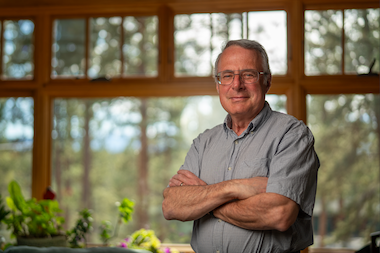
Like a lot of people — a lot of men, especially — Mike Caccavano put off his first routine colonoscopy for years.
He even joked about it, he said in a recent interview: “My primary care nurse practitioner said, ‘You know, you should think about getting a colonoscopy.’ And I said, ‘Is that good enough? Can I just think about it?’”
Without missing a beat, the nurse replied, "you've been thinking about it for eight years" and urged Caccavano, then 58, to quit delaying and schedule the routine procedure, which is recommended as a screening for colorectal cancer. (The recommended age to begin regular colonoscopies was 50 when Caccavano got his first; it is 45 now.)
Caccavano followed orders and scheduled his procedure, which found a polyp.
“They said, ‘There’s an 80% chance it’s nothing,’” he said. “But it wasn’t nothing. It was cancer, and it had spread into a few nearby lymph nodes.”
An optimist by nature, Caccavano’s reaction was a mix of shock and fortitude.
“I thought a lot about my family, and my wife in particular, because I was the main money earner,” he said.
“And I thought about my four kids,” he continued. “My daughter came to me and said, ‘You know, Dad, mental attitude makes a big difference. I’m not worried about you because you’re optimistic, but stay that way.’”
Caccavano did just that. Through surgery to remove three inches of his colon and six months of chemotherapy, he was determined to beat the disease. He started his treatments at St. Charles’ Cancer Center in Bend but switched to Redmond Cancer Center because he liked the smaller infusion room, where closer chairs led to conversations with other patients.
“You can’t help but hear the person next to you talking, so you turn and you end up talking to them and that kind of distracts you from what you’re doing,” he said. “That little bit of interaction with other people who were going through the same thing — it was a good atmosphere. It felt very friendly, and you didn’t feel isolated.”
Caccavano’s wife, Clarissa, sat with him and knitted socks through most of the infusion sessions.
“Regularly, a nurse or a patient would come over and say, ‘Oh that’s beautiful. How do you do that?’” he said. “It was those kinds of interactions that made everything feel a little bit better.”
He found inspiration, too, in his caregivers. His oncologist, Dr. Richard Reed, emphasized the science behind treatments and talked about success rates — a data-driven approach that resonated with Caccavano, a former engineer with the City of Redmond. And his nurses were straightforward, attentive and consistently upbeat, he said, which aligned with his own approach to his cancer journey.
“Everything they’d say, I would listen,” Caccavano said, “and absorb the positive part.”
He won his fight, by the way. Nine months of treatment did what it was supposed to do, and five years later, Caccavano was declared cancer-free. Now — nine years from that first colonoscopy — he is thankful for the care he received and the folks he met along the way.
“I left there with a new understanding that these wonderful people exist and they’re there to do whatever they can to take care of you and make it as easy as possible — not just for you, but for all the other patients, too,” he said. “I always try to look for the good in experiences (but) I didn’t have to look very hard on this one. The chemo was not fun, of course. But the people — they were wonderful.”
Learn more about St. Charles Cancer Institute.